Showing posts with label Juvenile Fiction. Show all posts

Friday, September 6, 2013

Theodore Boone: The Activist – John Grisham


 Theodore Boone: The Activist
© 2013 New York, Dutton Children’s Books

This is the best Theo Boone yet!

There now that the blurb is out of the way, you’ll want to run down to the local library or bookstore and obtain a copy of this little YA gem.

This time, Theo puts his debate team skills to not only defeat his opponents from the cross-town rival team, but to try to help save his friend’s family farm. It seems that all the politicians in the state and the businesses in the county want to push through a by-pass project which will displace a number of families on the outskirts of town at a cost of multiple million dollars while schools are getting shorted in the funding department.

Theo learns some valuable lessons about activism and ethics as he works through his case this time.

This is some of the better writing involved in the Theodore Boone series (see opening sentence above). It is one of the very best examples of internal struggle available on the current market. The moments where our protagonist wrestles with what is right, wrong, and just are on a par with FrankStockton’s classic short story “The Lady, or the Tiger?

I can’t hold back my five reading glasses for this excellent example of juvenile suspense.

—Benjamin Potter, September 6, 2013

Tuesday, March 26, 2013

Theodore Boone: The Accused – John Grisham


©2012, Dutton Children’s Books, New York
The Accused (Theodore Boone Series #3)


In his third outing as an author of juvenile fiction, John Grisham is showing a practiced hand. Not only is the hero (Theodore Boone, Kid Lawyer) a likable young man, he is also extraordinary. How many thirteen year old boys are all but partners in their parents’ law firm? How many are liked by everyone? How many smarter than the entire staff of their Junior High School? Well . . . in real life probably none. But in Strattenburg, there’s only one – Theo Boone!

Opening paragraphs of The Accused call on readers to remember TheAbduction (Theo’s sophomore appearance) with the beginnings of the re-trial of Pete Duffy for his wife’s murder. But the defendant has disappeared. [Readers who missed the first two books in the series will want to catch up with Theo’s cases from the very beginning.]

What follows is not focused on Duffy (although his case is a running thread throughout the story), but rather on Theo’s travails as a victim of sabotage, vandalism, and framing. We know that he’s innocent, his parents and uncle know he’s innocent, the faculty and administration of Strattenburg Junior High know he’s innocent. In fact, it seems that everyone knows that Theo is innocent except for the police.

A couple of things are disturbing about this book: the helpless feeling the reader gets as his hero is being hounded by the police as well as his stalkers (this can be chalked up to the good writing). Perhaps even worse, though, is the thought that police can enter a school and use the same bully tactics which one sees on television with a thirteen-year-old. And this without his parents or lawyer (in this case both might be the same) present—and when the parents do enter the scene, they make no fight for a minor having been treated so. [Note: since I am not an expert in the law or in police procedure, I would not claim to know the legality of this—I just find it disturbing.]

On a lighter side, readers will enjoy the moment from Animal Court. It provides a needed rest from the struggle of fighting an unknown assailant, and gives more than a laugh or two.

Again, Grisham fans will be satisfied, as will suspense and young adult mystery readers. The writing is on par, the action is compelling and the characters are well-developed. I give Theo Boone’s third story The Accused four out of five reading glasses.

—Benjamin Potter, March 26, 2013

Friday, October 26, 2012

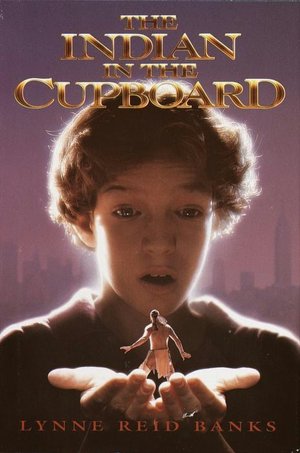
The Indian in the Cupboard – Lynn Reid Banks


The Indian in the Cupboard
© 1980 Doubleday, New York


In 1995, film-makers at Scholastic introduced movie audiences to the story that is The Indianin the Cupboard, a wonderful example of juvenile fiction from yet another talented British author. As with most movies, there are a number of departures from the original book on which it is based. But the good news is that this story got a wider exposure and children who had not yet read Banks got a chance to find this magical story.

This book is the first of five that were published over a nearly twenty-year period. I will be attempting to read others in the series over the next months when time permits.

Here is the story of a young boy (Omri) who receives a magical medicine cabinet (cupboard in British) for his birthday. Whether the magic is in the cupboard or in the key that Omri’s mother gives to him or in the combination of the two is not revealed in the story, but when used together plastic men come to life—only in miniature.

During the course of a few weeks, Omri learns that it is not really fun to have a “little man” to play with, but more of a responsibility. He learns how fragile people can be in relation to the world in which they live. He learns what it is to care for and be responsible for a human who is at once demanding and spectacular.

Banks is masterful in combining the culture of a British school-boy with real-life historical people such as an Iroquois from the French and Indian War era of the United States and a cowboy from the late nineteenth century western US. As he learns from his miniature friends, Omri and his best friend Patrick learn that the western movies that they have watched don’t depict the life of Cowboys and Indians as accurately as they thought. All Indians do not ride horses and live in teepees. Not all cowboys are as rough and tumble as the films have taught them.

This book was lauded by the New York Times and the movie does a pretty good job in retelling the story. As in most instances, there is much more to be enjoyed in the book, but the film is a good companion and even introduction. I recommend both to young readers and families who like magical adventure.

Five out of five reading glasses.

—Benjamin Potter, October 26, 2012

Friday, April 27, 2012

Congratulations, Matthew J. Kirby

I just learned that Icefall - Matthew Kirby's saga-istic (if it's not a word it should be) story about young woman becoming the storyteller she is meant to be - recently one the Edgar award for best juvenile fiction. (Thanks to my news source, Bill Crider.) Two things I'd say: (1) Great out of the box thinking to the Mystery Writers of America for including this historic saga in the running. Most would not classify it in the mystery genre. (2) And while Icefall is a good story, I preferred Kirby's debut outing with The Clockwork Three (which coincidentally I just finished re-reading as a bed-time offering for my offspring, 5, 8, & 10; and they thoroughly enjoyed it, too).

That said, CONGRATULATIONS! Matthew J. on a job well-done. Keep up the good work, and let us know how the next story (-ies?) turn out!

Sunday, October 2, 2011

Michael Vey: The Prisoner of Cell 25 – Richard Paul Evans


© 2011, Simon Pulse/Mercury Ink, New York

Richard Paul Evans burst on the publishing scene in 1995 when an alert executive at Simon & Schuster noticed his self-published Christmas story The Christmas Box. I’ve read many of his successful stories including the trilogy that came out of the original Christmas story, others of his romantic fiction (some better than others) and several of his children’s book which are dedicated to the Christmas Box House that benefits children. Now he is turning his pen to the new arena that is luring many successful authors (like John Grisham)—Young Adult fiction.

I like YA fiction for a variety of reasons: It reads quickly (authors go out of their way to use readable language); and speaking of language, most YA stories are free of vulgarity and innuendo (which forces the author to use a vocabulary filled with clean language); most of these works have a little romantic tension even though the graphic details are left out (and I really enjoy stories that are free of material that cues my internal censor).

The Prisoner of Cell25 introduces an anticipated collection of works about the Electorclan—a group of children who through some quirk of fate were born with abilities that can be traced back to electricity. Some call this small group of children “electric children”. Several of the children have been tracked down and abducted by the evil, maniacal genius Dr. Hatch whose invention caused the accident in the first place. Hatch is backed by a consortium of people who are trying to duplicate the events that created the electric children in order to conquer the world.

Michael Vey and his friend Taylor Ridley are the last two of the electric children to be found. Hatch gets Taylor back to his compound and tries to turn her into one of his servants as he has done with many of the other children including Taylor’s twin sister Tara (who Taylor has never heard of). His efforts are in vain when he asks the girl to hurt strangers as a proof of her loyalty.

There is much to be enjoyed in this first Michael Vey story. Most readers will look forward to the second story in the series which promises to follow the Electroclan as they help Michael search for his mother and answers to questions about his past.

Even so, there are a few distractions that may crop up. There is an uncanny resemblance to other Science Fiction/Fantasy mainstays that already have the hearts of SciFi fans. Specifically, Evans seems to be drawing heavily on story lines from the X-men and Heroes franchises. Even so, there are enough new items to overlook the resemblance.

That said, I’m looking forward to the next installment. 4 out of 5 reading glasses.

—Benjamin Potter, October 2, 2011

Friday, July 8, 2011

Theodore Boone: The Abduction – John Grisham


© 2011 New York, Dutton Children’s Books

Theodore Boone is back! When author John Grisham introduced the “Kid Lawyer” last year he suggested that he intended to write a series of juvenile books featuring the 13-year-old legal whiz. His purpose: open up his main genre to a younger audience. The pay-off: another generation of readers to get turned on to the likes of The Firm and The Pelican Brief as they get older. Perhaps he’s onto something.

In this episode, Theo’s girlfriend and classmate, April Finnemore, is missing. The entire town of Strattenburg turns out to look for her and is turned upside down as information begins to surface. Distant relative and general reprobate Jack Leeper has coincidentally escaped from prison in California, has been seen in Strattenburg, and has been known to correspond with the eighth-grader. Police find in him a perfect suspect. Theo’s Uncle Ike offers another choice for the eighth-grade boys to focus on: April’s rarely seen, washed-out musician father.

Action begins with the first sentence of the book: “The Abduction of April Finnemore took place in the dead of night, . . .” and continues page after turning page. Young adult readers will enjoy it; intermediate readers will, too; in fact, Grisham fans of all ages will like the fast-paced stories featuring Theo Boone. This great summer fare warrants four and one-half out of five reading glasses. I, for one, cannot wait for the next story starring my favorite teen-aged lawyer.

—Benjamin Potter, July 8, 2011

Sunday, July 3, 2011

Sir Rowan and the Camerian Conquest – Chuck Black


© 2010 Multnomah Books, Colorado Springs

Chuck Black has entered another in the annals of the Knights of Arrethtrae series (apparently the last), and it’s another story well worth reading.

Mixing the popular end times stories loosely based on the book of Revelation from the Bible and his own medieval tales of swordplay and honor, Black gives another astounding, challenging, and entertaining story.

Rowan is an orphan living in Laos (part of the Kingdom of Arrethtrae located in Cameria) where he finds work and lodging as a stableboy. Rowan studies the valiant knights as they participate in the tournaments that have become famous throughout Cameria. A chance meeting with Sir Aldwyn places Rowan on the road to becoming a true Knight of the Prince—committed to the King, His Son, and the Code.

But fame and fortune lure the young knight into the arena of the tournament. And there he finds his niche—although Aldwyn had hoped for better for him.

Captured, bound and left for dead, Rowan realizes too late his mistake and calls out to the Prince. Rescued by an improbable benefactor, Rowan joins the Resolutes in the hills outside of Laos, all the while a mysterious knight in dark armor beckons him to a higher mission.

In closing the series that selects a few of the tales of the Knights of Arrethtrae, Black delivers drama, love, heartache, triumph, regret and triumph again. Here is another thought-filled allegory to add to your reading list. Four out of five reading glasses.

—Benjamin Potter, July 3, 2011

[Disclaimer: I received this book for free from WaterBrook Multnomah Publishing Group for this review.]

Wednesday, June 23, 2010

Theodore Boone: Kid Lawyer – John Grisham


© 2010 New York, Dutton Children’s Books

In the year 2000, John Grisham did something different. He wrote a novel that was NOT about lawyers. Well, at least it was different for him. The book was originally published in serial form in the Oxford American literary magazine. Subsequently, Doubleday released the book version of A Painted House in January 2001. The author has since released other non-lawyerly stories (Skipping Christmas, also Doubleday 2001; Bleachers, Doubleday 2003; and Playing for Pizza, Doubleday 2007). Now he is again trying something new. This time he is entering the juvenile market—albeit with a lawyer novel.

Theo Boone is the thirteen-year-old son of two lawyers—his father, a real estate lawyer, and his mother a successful divorce attorney who only represents the wife. He loves court and all the drama therein. He even loves to watch old Perry Mason reruns with his parents. His dream vacillates between being a high-profile courtroom lawyer and becoming a powerful judge in that same courtroom. In his eighth-grade class, he is the go-to guy for all problems involving the law (from escaped and impounded dogs to arrested brothers). In the midst of the biggest murder trial to hit the town of Strattenburg, Theo finds himself in possession of the only evidence to guide justice. And he’s promised not to tell anyone.

This is a fast-paced novel which is a great introduction to “lawyer fiction” for most readers. Appealing about this book is the moving story with rich characters and the absence of foul language and sex scenes that permeate courtroom dramas aimed at an older audience. You can almost overlook the main drawback—scenes that seem to drop a line or two, requiring the reader to fill in a bigger gap than he should.

For this excellent effort in introducing his writing to younger audiences, I can award Grisham a solid four out of five reading glasses.

Benjamin Potter, June 23, 2010

Popular Posts

Labels