Showing posts with label WaterBrook. Show all posts

Wednesday, September 20, 2017

Convicted – Jameel McGee & Andrew Collins (with Mark Tabb)


©2017  Waterbrook Press, New York


The caveat on the cover of this book reads: “A Crooked Cop, an Innocent Man, and an Unlikely Journey of Forgiveness and Friendship.” When I saw the title and the cover of the book, I was intrigued. Since I usually turn to mysteries or suspense novels (with a western thrown in for good measure) for my leisure reading, and concentrate on mostly ministerial books as a general rule for work, I find that the “True Crime” genre rarely catches my attention. But this one looked like it might be worth a minute or two.


I received the book in the mail about two days before leaving the country on a personal trip that wouldn’t allow time to read (even on the plane—which I don’t read well on planes anyway). So, I socked it away with the hope of getting into it upon my return. I was pleasantly surprised by my reaction to the book. From the first page of the prologue (don’t skip the opening “Author’s Note” for background, but the story doesn’t start until the prologue) I was hooked. I almost wished that I hadn’t read the descriptor on the cover, though, because from the very outset my reader’s mind was set against the cop (one of the book’s voices).


The story is exactly as advertised: an innocent man gets caught in the cross-hairs of a policeman doing whatever he can to put criminals away—which includes fudging with the truth to a certain extent. After all, in the neighborhood where he works, most of these people are drug users or dealers anyway, right? Within these pages you will read the sad state of corruption that plagues police departments (and is, one must say the exception rather than the rule). The outcome of the story is that once the cop (Collins) was caught in his web of deception, he had to come clean with details of all the arrests he had made that had been compromised by corrupt practices. All of which were overturned. Meaning that a lot of guilty criminals went free because one dirty cop wanted to cut a corner or two—in the service of justice.


At the same time the story is about a man just about to embark on a promising future (especially coming from the neighborhood in which he lived), who gets caught in the wrong place at the wrong time, by the wrong policeman, with the wrong friend. It is a case of mistaken identity, misused power, and misplaced trust. And the result is a three-year federal incarceration for an innocent man.


The final outcome of the story is not such a depressing thing though. With all of the ill-will, all of the bad blood, and all of the system abuse, Convicted is the story of how God uses unusual circumstances to bring sinners into relationship with Him. Even more, it is the story of how two men who start out as mortal enemies—and according to all conventional wisdom should remain so until they reach the grave (maybe at each other’s hand)—become friends through forgiveness only available through Christ and knowing Him.


I heartily recommend this book to anyone and everyone. It has action, suspense, and an unusually unexpected happy ending. It’s in stores or online today. And read this 5-reading glass treasure about forgiveness.


—Benjamin Potter September 20, 2017


[Disclaimer: I received this book for free from WaterBrook Multnomah Publishing Group for this review.]


Friday, June 2, 2017

Life After – Katie Ganshert


©2017  Waterbrook Press, New York

Life happens. That is the thread running through this fast-paced romance by Christy Award-Winning Katie Ganshert. I can attest to the fact that life happens as I sit down to write this review (three months late). May I whine just a bit? I started reading the book and was well on my way to finishing it when I slipped on the ice and broke my dominant wrist. So much for typing up the review when I finished reading the book. Then, as does for all ministry types like me, life happened some more. Things got busy at church, things got busy with the busy family, and then a major funeral happened. And so, here I am, three months later, and I have a little more thought into the book than I normally do. (Excuses over, now on to the review.)

 Not being familiar with Ganshert’s work, and desirous to see how my review would turn out, I checked out a copy of an Amish Christmas romance that was written with the contribution of Ganshert and others (Amish Christmas North Star, WaterBrook, 2015). What I found there (in Katie’s story from the book) was a moving story with well-developed, likable characters to push the story along. Consequently, I began to look forward with a little less trepidation to examining the latest book from this author unknown to me, in a genre normally not read by me.

Set in Chicago, the story starts off with a BANG when, well, life happens. On an icy, snowy day, a commuter train derails destroying lives and homes all over the city. Only one passenger survived. The book follows her story, as Autumn Manning comes to grips with her role in the “Tragedy on the Tracks” as the event is labeled in the media. While all her friends and family are trying to figure out why she is not happy, does not feel fortunate, that she didn’t die in the accident, Autumn is filled with regret, remorse, and guilt spurred on by the continually lingering question Why? All the while struggling with a lingering amnesia that her doctors and psychiatrists are hoping to help her move past.

In ensuing pages, Autumn finds her life entangled with the lives of the families of those who died in the tragedy, including Paul Elliot and his daughters. Originally thinking that his wife is the lone survivor, Elliot arrives at the hospital to find a stranger in his wife’s bed.

Ganshert develops the main characters well, but some of the supporting parts are played by people we just don’t want to like, even when we want to like them. Perhaps it is the role they play (Autumn’s former boyfriend who shows back up to help with a memorial that Autumn finds herself not only entangled in but in charge of, for instance—you’ll need to read the book to get the whole story, otherwise I’d have to spoiler alert you).

The story has everything that a romance reader is looking for: likable characters, plot twists, semi-steamy love scenes, emotional conflict, and perfect resolution (the right guy gets the right girl and all is well in the end). For someone who rarely reads romances, I was pleasantly surprised. I’ll give Life After 4 out of 5 reading glasses.
—Benjamin Potter August 31, 2012

[Disclaimer: I received this book for free from WaterBrook Multnomah Publishing Group for this review.]


Tuesday, January 17, 2017

Coming Soon from Katie Ganshert

Author Katie Ganshert has a new book coming soon. If you're a fan, or interested in exploring exciting new authors, take a gander at the spectacular pre-release package below.


And stay tuned here for more news about Life After.


Friday, April 19, 2013

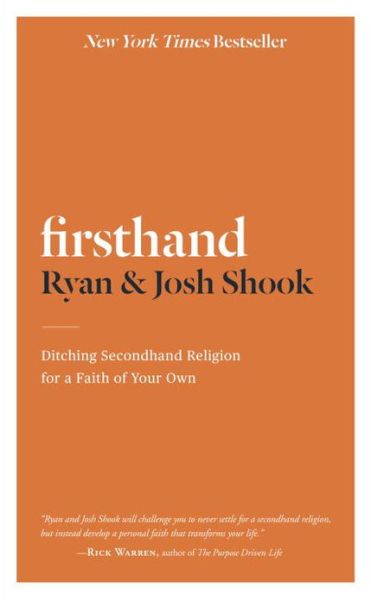
Firsthand – Ryan & Josh Shook


Firsthand: Ditching Secondhand Religion for a Faith of Your Own
[Update! My video endorsement of Firsthand by Ryan & Josh Shook can be viewed at my YouTube channel.]

©2013  WaterBrook Press, Colorado Springs

Brothers Ryan and Josh Shook grew up in church. In fact their parents planted a vibrant, exciting church in Houston. Now they are actively seeking careers far away from Houston. Ryan is a filmmaker living on the west coast, while Josh is a musician living in Nashville. And though they seem to be far removed from their roots in Texas, they write a book about how their faith roots are stronger than ever.

In a day when more and more people in the younger generation (in this case an age range of 16-26) are growing disillusioned with the faith of their parents, the Shook brothers have found the secret to faith that is lasting and real: stop playing at religion that is at best a hand-me-down from your parents and replace it with a firsthand, no-holds-barred relationship with Jesus Christ.

This book is less of a “how-to” book and more of a “what could happen” vision. Starting with their own wandering away from their parents’ faith and building on that with interviews and candid remarks from a number of people who had discovered the difference between plastic religion and real relationship, the authors weave a story that is at both challenging and a bit unnerving. There is no sugar coating here, just real admission of attempts and failures followed by struggle and success. Bottom-line advice from these two young men who have “been there” is to stop trying to be a Christian (based on what was handed down to you from your parents), and just build a relationship with Jesus.

This short 8-chapter book deals with all the things that church-goers try to do to get in good with God, and gives testimony and example of how one might stop going through motions and let their relationship grow. Their term, as the title suggests, for this authentic experience is “firsthand faith.”

This book is a good starting point when someone has grown disappointed in the church experience of their roots. While believers are encouraged to do the things that our church society has done as a sign of their relationship with Christ, the motivation is moved from marking your checklist of being a good Christian, to letting the actions flow from who you are.

Even so, because the book is focused on the generation of younger adults, those who are approaching or have even passed middle age who are dealing with the same questions about faith are neglected. This is not necessarily a fault of the authors or the publisher but a drawback built into focusing on a particular audience, limiting further (with age) an already limited audience (Christians or Christ-seekers). That said the book has value when someone (of any age) is struggling with whether what they’ve always believed is really real—especially when it is believed because that’s what they (or their family) has always believed.

Each chapter includes a sampling of quotes from a handful of the people interviewed in the researching of the book, some questions for deeper thought, and some practical application suggestions to put what the preceding chapter has discussed into action.

I would suggest that pastors and youth pastors, as well as collegiate ministry workers, would want to have a copy or two of this book handy to help young people who are dealing with questions of whether the faith they espoused at the age of 8 or 9 is real or not. The struggle of authentic faith is one that has been around for ages and will continue to haunt the church. In Firsthand the church has a resource to address this struggle head-on. I give the book 4 out of 5 reading glasses.

—Benjamin Potter April 19, 2013

[Disclaimer: I received this book for free from WaterBrook Multnomah Publishing Group for this review.]


Friday, August 31, 2012

When Bad Christians Happen to Good People – Dave Burchett

When Bad Christians Happen to Good People – Dave Burchett

When Bad Christians Happen to Good People: Where We Have Failed Each Other and How to Reverse the Damage©2002, 2011  Waterbrook Press, Colorado Springs

You just can’t go wrong with a title like When BadChristians Happen to Good People. And Dave Burchett (who is NOT a theologian by profession, by the way) backs it up with the subtitle “Where We Have Failed Each Other and How to Reverse the Damage.”

I will be the first to admit that the lion’s share of books available in Christian bookstores today that are aimed at helping Christians be more like Christ have a strong bent toward finger-pointing negativity. Our preaching tends to do the same. Either Christians are pointing accusatory fingers at the non-Believers around us highlighting the sin that is dragging them straight to hell, or we are involved in abusive name-calling of one another reminding each other how short we come when measuring up to our image of what Christianity should look like. (May I raise a quick “guilty” hand admitting my own participation in this unhealthy faith? We can work on it together.)

Many of these books (and sermons) are coming straight from the studies and mouths of some of the most sought-after Christian preachers and writers today. And then Emmy Award-winning television sports director Dave Burchett throws in his two-cents’ worth. Perhaps it is his lighter tone, or the fact that he is a non-clergy-type taking an honest look at what the Christian church is and has become that is appealing, but whatever the cause, in this second edition of his book, we find a sincere call for Christians to be more, well, Christian.

Burchett uses examples from his own experience with the unforgiving air of the forgiven and encounters with others who are actually living like Jesus to weave a Christian Living book that is arguably the most helpful one in the market today. He not only points out the shortfalls that have given the church a black eye over the years, but he also drops the answer to such failings throughout the book. The answer, according to the book, is to stop trying to be a good Christian and let Christ through His grace take care of that for you.

This book has and will earn its author more headaches at the hands of the self-righteous bunch of Christians who are monitoring the halls (his allusion, not mine), but no one expected shining the light on unpopular truth to be easy (history is filled with the blood-stories of martyrs who have proven this). What makes this book worth your while if you are a Christian is it’s readability and its personable approach to becoming more like the One whose name we bear.

If you happen to find a copy of the original 2002 version of the book, go ahead and read it, but if you can get your hands on the new 2011 edition (with some newer material and a softer tone), I would suggest it as the one to read. In fact I think it deserves 5 out of 5 reading glasses.

—Benjamin Potter August 31, 2012
 
[Disclaimer: I received this book for free from WaterBrook Multnomah Publishing Group for this review.]


Tuesday, May 29, 2012

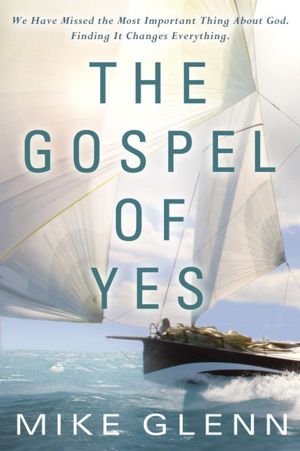
The Gospel of Yes – Mike Glenn


The Gospel of Yes: We Have Missed the Most Important Thing About God. Finding It Changes Everything© 2012 WaterBrook Press, Colorado Springs

In the panoply of inspirational books encouraging Christians to be Christian one can find a multitude of definition books. David Platt stresses that we live Radical lives. Thom Rainer suggests that we find a way to Simple Church and Simple Life. It is great to be challenged, but at some point it would be nice to move from motivation to practice. Enter Mike Glenn, senior pastor of Brentwood Baptist Church in Brentwood (read Nashville), Tennessee. What Glenn does that sets his book apart from others who challenge the church to be Christ-like is to put a handle on what it takes to simplify, and do it radically.

Having grown up in the Southern tradition of nos and don’ts and stop that’s, Glenn has stumbled onto something that is more practical and freeing than the rhetoric that says, “Christians ought to . . .” Simply put, the author opens the reader’s eyes to a fresh emphasis on a couple of Scripture passages. The foundational passage for the book is one that throughout the ages has been used to encourage integrity in the Christian—“Let your ‘yes’ be ‘yes’ and your ‘no’ be ‘no.’” (see Matthew 5:37) Glenn suggests that Christ has a “yes” for every believer, and that to say, “yes” to that yes in our lives will automatically require us to say, “no” to a number of other things, even good things. It is your yes that you must follow, not anyone else’s.

This refreshing take on Christian living helps to free up the believer to be all that he can be without being distracted by all the other good things there are open to us. The principle, as I see it, can be well learned by the church as well.

The writing is not without its hiccups. For instance, in the Introduction and first chapter of the book, Glenn is desperately trying to communicate his epiphany about the “gospel of yes” with limited or little success. However, as the reader moves into the following chapters, the idea becomes a tangible thing that can be grasped. This personal “yes” presented to every believer by God Himself is one that finds its way into all the Scripture.

Approaching a passage used by parents throughout the ages (both in and out of the church) to bully their children into proper behavior from the standpoint of God’s “yes” changes the emphasis from a child towing the line, to helping that child find her niche. The passage found at Proverbs 22:6 advises, “Train up a child in the way he should go, and when he is old he will not depart from it.” Throughout the ages parents have put the emphasis on the way trying to drag their children along with them on a path of Bible memorization and church attendance (not necessarily a bad thing). But Glenn suggests moving the emphasis from the pathway to the person—train a child in the way he should go—help him find his place and direction. If we will do this then our children will not only excel in the direction that is theirs, but they will also be following the “yes” offered to them by God Himself (which will keep them in the path that He has chosen for them—including the moral places we want them to be).

This is a challenging book in the respect that it forces us out of our comfortable world of nos and negatives, but it is also a more encouraging book for the Christian. We learn that it is okay to say, “no” to even some of the good things (if they are not part of our “yes”), and we learn that even when the going is difficult, following Christ is a reward in and of itself. Thanks for the re-wiring, Mike. Not only could this preacher/reader use it, but I think it will be helpful for the church in general. (four out of five reading glasses)

—Benjamin Potter, May 29, 2012

[Disclaimer: I received this book for free from WaterBrook Multnomah Publishing Group for this review.]


Wednesday, November 30, 2011

Here's a Contest

 
Click on the logo to enter the Christmas Contest!

Popular Posts

Labels