Friday, December 31, 2010

A Tardy Christmas List

Books to Read for Christmas

Now that the 2010 Christmas season is behind us, I thought I’d make a list. (I must admit that the fact that Sherry over at the Semicolon blog is dedicating this week’s Saturday Review of Books—links to a variety of reviews by reviewers all over blogdom—to lists of reading suggestions helps, too.) My list is dedicated to books that you must read for your Christmas pleasure. I’ll admit, this is a favorite topic of mine, and sometimes I don’t even wait until Christmastime to read a book or story centered on the Nativity or even any of the legends that have been established all over the world at this time of year. So, if you have an inkling to be Christmas-y during 2011, pick one of these up and enjoy some hot cocoa. Finally, in addition to the Gospel account in Luke 2, and of course (beware of shameless self-promotion) either Something Special at Leonard’s Inn by yours truly, read some of these classics and ought to be classics:

Ø A Christmas Carol by Charles Dickens

Ø How the Grinch Stole Christmas by Dr. Seuss

Ø The Polar Express by Chris Van Allsburg (well-deserved Caldecott winner)

Ø Miracle on 34th Street by Valentine Davies (an early version of novelization of a popular movie)

Ø The Christmas Chronicles by Jeff Guinn (three novels now available in a single volume, the collection includes

o The Autobiography of Santa Claus

o How Mrs. Claus Saved Christmas, and

o The Great Santa Search

Ø The Christmas Box by Richard Paul Evans (others in the trilogy are okay)

Ø Christmas Jars by Jason F. Wright

Ø The Judge Who Stole Christmas by Randy Singer

Ø Magi by Daniel L. Gilbert

Ø The Christmas Wish by Richard Siddoway

Ø The Paper Bag Christmas by Kevin Alan Milne

Ø The Christmas Shoes by Donna VanLiere

Ø The Christmas Child by Max Lucado

Ø The Greatest Gift by Philip Van Doren Stern (the story that inspired the classic movie It’s a Wonderful Life)

Ø And don’t forget this year’s collection of stories—The Nativity Collection—by Robert J. Morgan

And while you’re enjoying Christmas reading, don’t forget to find a copy of O Henry’s classic short story “The Gift of the Magi”


Merry Christmas and Happy New Year everyone (Sorry I haven’t linked all the books or reviews, but most are available at your favorite brick and mortar or on-line bookstore). To see most of my reviews of books on the list, just click the Christmas link in the “Labels” sidebar


—Benjamin Potter, December 31, 2010

Thursday, December 30, 2010

One Precious Pearl – Robert Lloyd Russell

© 2010 Infinity Publishing, West Conshohocken, PA

Every so often an author or publisher will stumble across this review blog and read one. Having done so, they might contact me to see if I’d be willing to review their book. If it sounds like something of interest to me, I’ll bite. That’s what happened a little over one month ago. And the result was a pleasant Bible study on a little addressed parable. Robert Russell is a Bible teacher and management consultant who takes his study of the Scriptures seriously. He has written other articles and books including a previous volume in this study series, and has edited a collection of the words of Missionary/Martyr Jim Elliot.

One Precious Pearl: God’s Design for His Church studies the parable known as the Pearl of Great Price found in Matthew 13. The author acknowledges that this particular parable has often been neglected in favor of other parables surrounding it, but insists that this simple parable is one that holds an ocean of wisdom for the church. Dividing the study into two sections, Russell presents background to the parables of Matthew 13, and then draws some lessons from the Pearl of Great Value.

One conclusion that is not necessarily part of the main-stream of thought, but bears credence since this is a lesser-dealt-with parable, is the idea that the Pearl is a reference to the Church (rather than the popular Kingdom; or the less than likely Salvation). In part II of the book, Russell compares the Church to a valuable pearl at length, and brings a new light—might I say, a new luster—to the images Jesus is presenting.

The chapters are kept short (between two to five pages in length) for easy access to the material. Even slow readers like Yours Truly can finish the entire book in a relatively short time. Such arrangement of the chapters makes the book ideal for devotional reading or for personal or small group study. The ideal audience for this book (and its companions in the Christian Concepts Series, one would assume) are Bible teachers, preachers, and students of the Scripture who are interested in learning more about specific passages. This book will find a worthy spot among my study materials and I’ll have another excellent resource the next time I’m preparing a study or sermon from Matthew 13. And you can, too. (four out of five reading glasses)

—Benjamin Potter, December 30, 2010

[Disclaimer: This book has been provided to the reviewer, free of charge, for the purpose of review. All opinions about the work are the reviewer's.]

Wednesday, December 29, 2010

The Nativity Collection – Robert J. Morgan

© 2010 Nashville, Thomas Nelson

I have kept it no secret (from anyone) that I love Christmas. I especially love reading Christmas-related books. With this in mind, my Blushing Bride discovered a new collection of Christmas stories to wrap and place under the tree for me. The author is Robert J. Morgan, pastor of the Donelson Fellowship Church in Nashville. Morgan is also the writer/compiler behind such devotional connections as Then Sings My Soul and On This Day in Christian History. In this collection, he brings his love for Jesus, his communication skills, and the emotion accompanying the Nativity story to present a book filled with the Hope that pervades the Christmas season.

From the fly-leaf we learn that Morgan is in the habit of writing a new fictional story built around the Nativity to share with his congregation each Christmas Eve. Reading this selection of six of these tales will make you want to trek to Nashville next Christmas Eve just to enjoy the next installment. Each of these stories is well-crafted and brings to mind Christmases past and present. You will relate to the characters as they renew their joy in Christmas, in Christ, and in Life.

The book opens with “Ollie” which reminds us that Christmas has more to do with relationship and less to do with presents than most Americans are ready to admit; includes a Christmas honeymoon story (entitled “Nativity Seen Smiling,” but that I would have called “Felipe Navidad”); “Poet Boy” – a hat-tip to Christmas Pageants; and closes with the most poignant address of Christmas I have seen in a great while. In all, there are six stories that draw our attention to the Manger of Bethlehem.

Don’t wait until next Christmas to purchase this little book. Get it today, prepare to be blessed, and prepare yourself to renew your own joy in the season, in the Savior, and in the salvation He brings. I give Mr. Morgan five out of five reading glasses for this book, and can’t wait for new volumes of these gifts he has given year after year to his church. Now, we can all share in the gift of story.

—Benjamin Potter, December 29, 2010

Tuesday, December 21, 2010

Radical – David Platt

© 2010 Multnomah Books, Colorado Springs

David Platt is the pastor of the Church at Brook Hills. Prior to this he lived in New Orleans until being displaced by Hurricane Katrina in 2005. He is a man of study and a man of vision (both of which play a vital role as he writes this book).

From page one, Platt not only challenges readers with Scriptural truth, but also shares genuinely about his own struggle with following a Master who poured His life into a handful of men while Platt himself leads the modern phenomenon known as a mega-church.

Within the pages of Radical, readers are confronted with the difficult truth that living the American Dream is not the biblical call to discipleship that we as Americans would like to believe. Chapters are devoted to giving up one’s own desires for the sake of spreading the gospel, and denying oneself in favor of feeding the hungry.

In a day when everyone is writing books about how to grow your church, how to get God to do things for you, how to make the most of your Christian life, Platt is a refreshing voice. He doesn’t sugar-coat the gospel; he doesn’t soft-pedal; he simply looks into the scripture and exposes our traditions and pet philosophies to the light he finds there. Consequently, one of his conclusions—that our salvation is not ultimately for our benefit (to get to go to heaven), but for us to have an opportunity to glorify God—flies in the face of the egocentric society that has developed in America (often in the name of Christ).

This is a book that should be read. Change that. This book is a MUST read for anyone who calls themselves “Christian.” The biblical foundation alone is worth the read, but the call back to living according to the teachings of Christ make it invaluable in the development of a Christian walk. So, I’ll say it over in another way, “Read this book.” (Five out of Five reading glasses)

Benjamin Potter, December 21, 2010

[Disclaimer: I received this book for free from WaterBrook Multnomah Publishing Group for this review.]

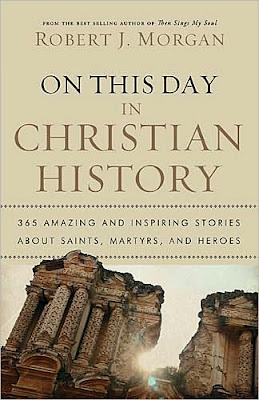
On This Day in Christian History – Robert J. Morgan

© 1997 Thomas Nelson, Nashville

Robert J. Morgan is a pastor and compiler. His inspirational devotionals include Then Sings My Soul (volumes 1 and 2), and he has a heart for developing devotional readers. In On This Day, he attempts to provide stories of inspiration from the lives of Christian Saints, Martyrs, and Heroes.

The book holds 365 stories from the life of the Christian Church. The stories range from the challenging to the bizarre, from the encouraging to the repulsive. Morgan offers a daily snapshot of life in the Church from her earliest days and into the twentieth century. Some of the stories will make you say hallelujah, while others will cause you to scratch your head in confusion (wonder?).

The author’s stated desire is to link each of the stories with a particular day in the year, and he takes great pains to do just that. Sometimes this connection is most natural, while at many other times it is forced and formulaic. Included are some of the more familiar (and almost overused) stories from the faith such as the well-worn story behind the writing of the great hymn “It Is Well with My Soul.” Other stories are more obscure—making them fresher to the reader.

Why read a book like this? As a pastor and speaker, I am always looking illustrations that speak to the heart—what better place than in a volume packed with stories. Others may want to have a “page-a-day” quick devotional thought. Would I recommend this book for inspiration or devotion? I would have to say no. While I would not go so far as to discourage reading of the book, I wouldn’t go out of my way to recommend it. That said, I give Mr. Morgan 3 reading glasses for his effort.

Benjamin Potter, December 21, 2010

[Disclosure of material connection:I received this book free from the publisher through the Booksneeze.com book review bloggers program. I was not required to write a positive review. The opinions I have expressed are my own. I am disclosing this in accordance with The Federal Trade Commission's 16 CFR, part 255: "Guides Concerning the Use of Endorsements and Testimonials in Advertising."]

Monday, November 15, 2010

Five Who Changed the World – Daniel L. Akin

© 2008 Southeastern Baptist Theological Seminary, Wake Forest, NC


Danny Akin is the president of Southeastern Baptist Theological Seminary, and he is a nut about missions. I know this because I was able to hear him speak last week at the Illinois Baptist State Association Pastor’s Conference. Our theme was “In It to Win It” encouraging pastors to keep running the race set before us. In all three of his addresses, Akin saturated the audience with images of mission work, mission activity, and mission lifestyles. So it is no wonder that he addressed his own seminary family with a series of sermons highlighting the lives of missionary heroes.


As the title suggests, this small volume inspires readers with the example of five missionaries who “changed the world.” In missions circles, and especially in Southern Baptist Life, the names of the missionaries are never far from the tip of the tongue. Akin studies the lives of these missionaries illuminated by Scripture passages chosen that seemed to be embodied by the people they are coupled with. In the almost 100 pages the reader will find William Carey—the Father of the Modern Missions Movement, Adoniram & Ann Judson—the first Baptist missionaries from America, Bill Wallace—a medical doctor who went to China and wound up martyred for his faith, Lottie Moon—the namesake for Southern Baptists’ international missions offering who literally gave her life for the Chinese she served, and Jim Elliot—brutally murdered by the people he brought the gospel to and whose surviving wife (Elisabeth) and daughter (Valerie) returned to South America to see Jim’s dream of believers among the “Auca” come to life.


The messages were inspiring to read, and they are a reminder to anyone who is a Christian of our task—“Go . . . make disciples. . .” Thanks for the inspiration Danny (and William, Adoniram & Ann, Bill, Lottie, and Jim). These winning sermons earn five reading glasses from this preacher.


—Benjamin Potter, November 15, 2010


Saturday, November 13, 2010

Preaching the Cross – Mark Dever, J. Ligon Duncan III, R. Albert Mohler Jr., & C.J. Mehaney

©2007 Crossway Books, Wheaton, IL


This is a collection of addresses that were delivered at the first (2006) Together for the Gospel conference. The catalysts for the conference are a group of Christian thinkers who have become friends over the years and their desire for their friendship to benefit other church leaders/pastors. The group includes two Baptists (Dever and Mohler), a Presbyterian (Duncan), and a non-denominational leader (Mehaney) who set aside their differences to focus on the main agenda—Christ and the Cross. Also appearing at the conference (and consequently in the book) are other popular preachers of our day—John MacArthur, John Piper, and R.C. Sproul.


Dever pens the introduction, speaking for the group, which outlines the history and make-up of the Together for the Gospel ideology. And then each person contributes a chapter dealing with a variety of aspects pertinent to genuine gospel preaching—Old Testament connections, Cultural responsibility, expository preaching, and the like.


Some of the addresses are exceptionally helpful, while others tend to drag. I found Dever’s treatment of I Corinthians 4, inspiring as a pastor, and Duncan’s highlight of preaching Christ from the Old Testament was certainly refreshing. Piper, who has a tendency to lose me after the first paragraph, continued to do so (perhaps I’m just not as intellectual as he is).


Altogether, this is a sound book for any preacher to have in his library. I would hesitate to recommend it to a larger audience out of simple interest appeal, though. Therefore I give it a rating of 3 out of 5 reading glasses.


Benjamin Potter, November 13, 2010


Saturday, October 30, 2010

Outlive Your Life – Max Lucado

© 2010 Thomas Nelson, Nashville

I like to read Max Lucado’s books. He seems to be everywhere in the Christian publishing community—Bible studies, Christian living books, the children’s “Hermie” series (where he even makes appearances in the videos), bringing his message of love for the world across the radio waves in the UpWords segments. Whenever I need to read something that is well-written, as well as easy-to-read, I pick up one of Lucado’s latest. He’s like the popcorn of the Christian books world—you love to read him, it goes down easy, and you might even want a little more.

Then I picked up this book. The writing was good, but the buttery lightness of popcorn was not there. All of a sudden, Max is making his readers draw or cross a line (real or imaginary), of commitment to truly live their lives. In this study of the first part of the book of Acts, Lucado draws a picture of “doing something about it” whenever a need arises. He challenges the modern church to imitate the Jerusalem church, and it is inspiring.

The book includes focal scripture for each chapter; excellent Bible study; superb illustrations; and a closing prayer of encouragement for the reader. Lucado makes us take a serious look at our response to famine, poverty, disease, and other pressing needs in our society and world, and then he closes with a chapter devoted to Christ’s injunction that “if you have done it to the least of these, you have done it to me.” Following the body of the book are discussion questions and action suggestions prepared by David Drury to make the book more practical for the reader.

I recommend this book, if you’re tired of a mediocre Christianity. I do not recommend it if you are pleased with yourself and your Christian walk. (5 reading glasses)

Benjamin Potter, October 30, 2010

[Disclosure of Material Connection: I received this http://BookSneeze.comhttp://www.access.gpo.gov/nara/cfr/waisidx_03/16cfr255_03.html> : “Guides Concerning the Use of Endorsements and Testimonials in Advertising.”]

Tuesday, October 26, 2010

Sun Stand Still – Steven Furtick

© 2010 Multnomah Books, Colorado Springs


You expect to read mixed reviews for things—books, movies, restaurants. You don’t often see them in the same review. But I find myself with mixed thoughts after having read Steven Furtick’s new book Sun Stand Still.


Steven Furtick is the founding pastor of Elevation Church in Charlotte, North Carolina. He is young. He is hip. He is everything that an up-and-coming pastor would want to be. What does he have that gets the attention of book publishers, and turns the head of readers? A good line and a noticeable presence. Elevation has grown to more than 6,000 attenders in three locations in four years—that’s noticeable. The first few pages of the book reveal several catchy, creative lines for the memory of the reader.


Basing his premise on the story of Joshua’s prayer mid-battle for the day not to end until the Israelites have completely defeated the enemy (see Joshua 10 for the full story), Furtick builds an argument for strong faith-filled prayer. The book is inspiring to the point of excitement. It is a reminder that we are to exercise extreme faith in our daily living, and daily prayer in our faithful living.


On the upside, the author speaks to a new, younger audience who may not be impressed with the age-old preacher filled with sweat and rage as he shouted the message to this new audience’s grandparents. Furtick opens scriptures to inspire Christians to build into their faith a God-sized desire.


Several things were not so exciting about the book though. First of all, the need for the author to create a dictionary to define his terminology: audacious faith; Sun Stand Still prayer; Page 23 vision, and the like. Also, the “Page 23 vision” itself is based on Jim Cymbala’s Fresh Wind, Fresh Fire rather than Christ. And especially, the tendency for the teaching to come across as a magic mantra which will cause the person praying to accomplish great things for God (though, the author spends several pages trying to avoid just this misunderstanding).


Did I enjoy the book? Were good ideas developed? Yes, of course. Is this a book I would recommend? I’m not convinced that it would be a helpful read. For this reason, I give it only two and one-half out of five reading glasses.


Benjamin Potter, October 26, 2010


Monday, October 25, 2010

What Is a Healthy Church Member? – Thabiti M. Anyabwile

©2008 Crossway Books, Wheaton, IL

Thabiti Anyabwile is the senior pastor of First Baptist Church, Grand Cayman Islands. He is also a former assistant pastor for Mark Dever at Capitol Hill Baptist Church in Washington, D.C. Is it any wonder that he would be part of the Nine Marks team? In a follow-up book to Dever’s Nine Marks of a Healthy Church and What Is a Healthy Church? Anyabwile offers some practical advice on what a healthy, growing church member looks like.

The author lists ten (instead of nine) marks of a healthy church member. The ten are parallels of Dever’s nine marks of a healthy church, and interrelated to them. As dealt with in the book, the marks are:

  • An expositional listener
  • A biblical theologian
  • Gospel saturated
  • Genuinely converted
  • A biblical evangelist
  • A committed member
  • A seeker of discipline
  • A growing disciple
  • A humble follower, and
  • A prayer warrior
Anyabwile includes evidence of scholarly research (though some might argue that it is heavy on Nine Marks theology throughout—but the reader needs to remember that it is part of the Nine Marks reading material) and a sample church covenant appended. The chapters on conversion and commitment are worth the price of admission.

What sets this book apart from most books that are being printed for healthy churches these days? This book is actually written with the church member in mind, instead of the focus on teaching church leaders how to produce healthy churches. The sad thing about this focus audience is that the book will rarely find its way into the hands of pew perchers (but I suspect any number of preachers will read it).

My advice—use this little book as a group study in a discipleship setting, or even as a new members’ class curriculum. It is worth four out of five reading glasses either way.

—Benjamin Potter, October 25, 2010

Popular Posts

Labels