Tuesday, July 24, 2012

When Zachary Beaver Came to Town – Kimberly Willis Holt


When Zachary Beaver Came to Town

©1999  Dell Yearling, New York

Sometimes you read a book and want to see the movie based on it. Sometimes you see the movie first. That’s what happened to me just a few weeks ago. The family and I were watching a really good family film based on Kimberly Willis Holt’s award-winning book. In this kind of scenario, I usually say that the book is better than the movie (when approaching Ernest Gaines’ The Autobiography of Miss Jane Pittman, forget about Cicely Tyson’s career mistake and read the book) with an occasional hiccup where the movie outshines the book tremendously (What the Deaf Man Heard was much better on the screen than its counterpart, Whatthe Deaf Mute Heard). But sometimes, just sometimes, you encounter something that is worth your while in either format because one’s not better than the other – they’re just . . . different.

When Zachary Beaver Came to TownConsider the nice little film released in 2006 and starring Jonathan Lipnicky (et al). Here we have a superb family film about small-town Texas, and all the quirks that endear it to us—regardless of where we really live. It earned a PG rating for some mild language, but over all you can sit down with even your younger children and a bowl of popcorn and laugh/cry your way right along with the characters. The acting is pretty good. The characters are developed to a point of recognition from the moment they hit the screen. The story flows with most of the events from the book with a few major variations that don’t really damage the plot itself. Some anomalies that hit you over the head are the military involvement of the best friend’s brother, which misses the book’s 1970s setting, and the use of email where Holt’s characters wrote letters. I’d recommend the movie for all ages of film-watchers.

On the other hand, the book is recommended for the thirteen and older group. My ten-year-old daughter is an excellent reader and would sprint through this book like it was water. She’s even quick enough to catch all the nuances of what’s going on in the book. But some of the themes addressed by the book, well, I’m not ready for her to have to tackle them. Even so, this is a well-written, smooth reading book that the YA audience and adult readers alike would enjoy.

Antler, Texas is a widespot in the road where nothing ever really happens. Nothing until Zachary Beaver, the “World’s Fattest Boy”, shows up that is. Follow along with the adventures of Toby and Cal as they learn about love, hate, anger, war, and death, all in the matter of a couple hundred pages. If the development of the characters in this book has any fault it is that the support characters are rather flat and the narrator is too nice—but we’ve all been in his shoes.

Check this book out of you local library, or buy it for your shelf, or find it in e-form—you will want to read this book. You’ll see why it’s on virtually everybody’s reading list. Watch the movie, too. It’s great family fare. Just remember, even with their similarities, they are (almost) entirely different enjoyments. (In other words, if you’re one of those who waits for them movie to watch instead of reading the book—read the book; and if you’re a purist who says you only read the book and don’t like movies based on books—watch the movie. In either case, you’ll be glad you did.) Book and movie—neither is to be missed. Five out of five reading glasses (or popcorn bowls) all around.


—Benjamin Potter July 24, 2012

Thursday, July 12, 2012

Real Marriage – Mark & Grace Driscoll


Real Marriage: The Truth About Sex, Friendship, and Life Together©2012 Thomas Nelson, Nashville 

In a society that is filled with preachers who are trying to re-invent church in order to appeal to a new generation, Mark Driscoll seems to have found a voice—at least in his home of Seattle where he leads one of the faster growing churches in one of the most un-churched areas of our country. The popular trend today is for some of these pastors to publish books based on their teaching concerning sex and marriage. So Mark and his wife Grace have teamed up to present their take on answering some of the formerly unaskable questions.

Quite frankly, the book does a good job of sticking with Scriptural basis for finding the answers to these questions. But also quite frankly, the authors sometimes deal a little more frankly than polite society would like for this topic to be dealt with. I think that there is an audience for this book, although it may not be the audience that the authors and the publisher thought of when producing and marketing this book.

It is not for the general public at large. I know that this is the way that it has been approached, but I believe that this book, along with others like it, will serve best as reference books in the hands of ministry leaders, Christian counselors and the like.

Even having said this, the advice they give concerning coming to grips with one’s physical past is sound, though sometimes over-generalized. At times the authors assume that every person inside and outside the church has some deep dark hidden sexual secret that must be exposed. The method of exposure advised is a “rip the bandaid off” approach that can lead to more scars than healing. Does such hidden past need to be brought out into the open? In most cases, yes. But this should be done with great care so as not to destroy the relationship that you are trying to heal.

Would I recommend this book? Cautiously. Do I think it could be helpful in certain situations? Probably. Do we need to use a “group study guide” to include this in our on-going church curriculum? I would advise against it. Therefore, I give this book 3.5 reading glasses out of five.

—Benjamin Potter, July 12, 2012

Illusion – Frank Peretti


Illusion


© 2012 Howard Books, New York


I’m not always a fan of Frank Peretti. Some of his early, highly-praised work moved a little slow for me. But I do get excited when acclaimed authors who stand on their faith treat us to another story. And so I was excited when I got an invitation to review his latest work of fiction. The short version of the saga toward this review is that my review copy never showed up before the early March deadline. Consequently, I got an e-copy in mid-April and finally got a chance to read it.

The story follows the life of Dane Collins following the tragic auto accident that took his beloved Mandy’s life. After forty years of marriage, the two well-respected magicians were preparing to open a new chapter off-stage, and move into semi-retirement in Mandy’s beloved Idaho. Suddenly Mandy is whisked back to the fairgrounds where she first met Dane before they met and the whirlwind begins.

Any more of the story line would be filled with spoilers, so I’ll stop there and give you the review. The book starts slow, with some jumps and starts. But as with Peretti’s TheOath, you are soon so involved in the lives of the characters that you want to keep reading until page 500 rolls around. This is a well-crafted story that requires more than a modicum of suspended belief. That’s okay though, because of the genre.

Genre issues bring up some other questions though—what kind of book do we have? Which audience will love this tale best? The author himself has the same questions in a short afterword. Of course, most bookstores will place this in the Christian or Inspirational Fiction sections simply because of the author. I would have no trouble shelving it with the romance novels (because it’s a love story), in the suspense section (because it’s filled with mystery), or even with the Sci-Fi/Fantasy works (because of the need to suspend belief to get into the story). Does the author achieve his goal of painting a picture of the love that Creator-God has for His church? I think so, although one would not necessarily read that into the story unless they had a tendency to do it.

If you’re a Peretti fan, you’ve probably already read this book—and if not you’ll want to. It isn’t classic Peretti, but it does expand his horizons without departing from his original foundation. The book addresses Christianity without being preach-y (which I really like). If you haven’t read one of this author’s books, Illusionis a great introduction to him and his writing. Readers of romance, mystery/suspense, or fantasy books will all be happy with this book. I give him five reading glasses for this new novel.

—Benjamin Potter, July 12, 2012


[This book was provided by the publisher for the purpose of review. No compensation has been given for this review. The opinions expressed are those of the reviewer. This is a review of the electronic version of the book.]

Tuesday, May 29, 2012

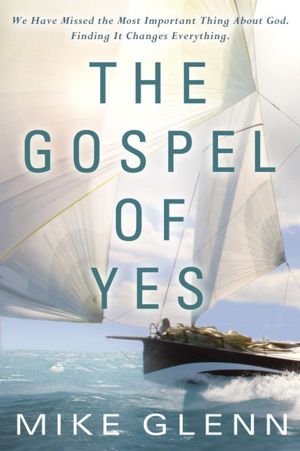
The Gospel of Yes – Mike Glenn


The Gospel of Yes: We Have Missed the Most Important Thing About God. Finding It Changes Everything© 2012 WaterBrook Press, Colorado Springs

In the panoply of inspirational books encouraging Christians to be Christian one can find a multitude of definition books. David Platt stresses that we live Radical lives. Thom Rainer suggests that we find a way to Simple Church and Simple Life. It is great to be challenged, but at some point it would be nice to move from motivation to practice. Enter Mike Glenn, senior pastor of Brentwood Baptist Church in Brentwood (read Nashville), Tennessee. What Glenn does that sets his book apart from others who challenge the church to be Christ-like is to put a handle on what it takes to simplify, and do it radically.

Having grown up in the Southern tradition of nos and don’ts and stop that’s, Glenn has stumbled onto something that is more practical and freeing than the rhetoric that says, “Christians ought to . . .” Simply put, the author opens the reader’s eyes to a fresh emphasis on a couple of Scripture passages. The foundational passage for the book is one that throughout the ages has been used to encourage integrity in the Christian—“Let your ‘yes’ be ‘yes’ and your ‘no’ be ‘no.’” (see Matthew 5:37) Glenn suggests that Christ has a “yes” for every believer, and that to say, “yes” to that yes in our lives will automatically require us to say, “no” to a number of other things, even good things. It is your yes that you must follow, not anyone else’s.

This refreshing take on Christian living helps to free up the believer to be all that he can be without being distracted by all the other good things there are open to us. The principle, as I see it, can be well learned by the church as well.

The writing is not without its hiccups. For instance, in the Introduction and first chapter of the book, Glenn is desperately trying to communicate his epiphany about the “gospel of yes” with limited or little success. However, as the reader moves into the following chapters, the idea becomes a tangible thing that can be grasped. This personal “yes” presented to every believer by God Himself is one that finds its way into all the Scripture.

Approaching a passage used by parents throughout the ages (both in and out of the church) to bully their children into proper behavior from the standpoint of God’s “yes” changes the emphasis from a child towing the line, to helping that child find her niche. The passage found at Proverbs 22:6 advises, “Train up a child in the way he should go, and when he is old he will not depart from it.” Throughout the ages parents have put the emphasis on the way trying to drag their children along with them on a path of Bible memorization and church attendance (not necessarily a bad thing). But Glenn suggests moving the emphasis from the pathway to the person—train a child in the way he should go—help him find his place and direction. If we will do this then our children will not only excel in the direction that is theirs, but they will also be following the “yes” offered to them by God Himself (which will keep them in the path that He has chosen for them—including the moral places we want them to be).

This is a challenging book in the respect that it forces us out of our comfortable world of nos and negatives, but it is also a more encouraging book for the Christian. We learn that it is okay to say, “no” to even some of the good things (if they are not part of our “yes”), and we learn that even when the going is difficult, following Christ is a reward in and of itself. Thanks for the re-wiring, Mike. Not only could this preacher/reader use it, but I think it will be helpful for the church in general. (four out of five reading glasses)

—Benjamin Potter, May 29, 2012

[Disclaimer: I received this book for free from WaterBrook Multnomah Publishing Group for this review.]


Wednesday, May 23, 2012

Erasing Hell – Francis Chan with Preston Sprinkle


Erasing Hell: What God Said About Eternity, and the Things We Made Up© 2011 David C. Cook, Colorado Springs

Francis Chan talks about Hell in this book. While the book is written from Chan’s point of view, he goes out of his way to give credit to his researcher, Preston Sprinkle. In fact, the Preface (p.9) attributes the bulk of the research and facts to Sprinkle. Regardless, this book is timely.

In a day when author after author is giving their take on what the afterlife will bring, Chan and Sprinkle offer not only an orthodox view of what Hell is, but also a level-headed one. The first half of the book focuses strongly on recent writings about Hell, with a pointed apologetic aimed at Rob Bell’s popular Love Wins. (I’ll not comment on Bell’s book specifically because I haven’t read it and don’t know if I’ll get around to that one or not.) In fact, while if what I’ve read in reviews and responses to Bell’s book are true then this is a needed response. However, since it comes across as a reaction to another’s writing weakens the book to some extent.

Even so, some of the questions that plague Christians are answered from a Scriptural standpoint:
Ø      Is there really a Hell?
Ø      If there is, what is it like?
Ø      Would a loving God really send somebody to Hell?

Chan even tackles the really tough questions that deal with what God is like. I have to ask along with the authors: What if God did do something that I consider unkind, would it make Him less God? (see chapter 6) The point that I cam away with that seems to keep coming back is that I am not God. Since I am not God, is it proper for me to impose my standards on Him? I would suggest that often when we do this we lessen who He is in exchange for exalting our own ethic upon Him.

In the end, I will read at least the last half of the book again and again, just for the challenge of remembering why I believe what I believe about God, Love, Justice, Righteousness, and yes, even Hell. (four out of five reading glasses)

—Benjamin Potter, May 23, 2012

[This is a review of the Nook version of this book.]


Forgotten God – Francis Chan


Forgotten God: Reversing Our Tragic Neglect of the Holy Spirit

© 2009 David C. Cook, Colorado Springs

The second of Chan’s books is arguably the best of the three. In this volume, Chan tackles a subject that has divided the church for centuries—God, the Holy Spirit. The author reminds readers that while most Christians of the evangelical stripe have no issue with God, the Father (Creator of all things), nor God, the Son (Savior of the world), we have a great amount of difficulty wrapping our minds around the Spirit of God who indwells us.

After addressing the extremes—the Holy Spirit is some magical power that expresses Himself the same way all the time in every Christian (represented by the strictest of Pentecostal believers) versus the Holy Spirit is there, but you don’t give more than a passing nod lest you become too charismatic (or “a charizmatick” as my mother-by-law would put it) as represented by my own Baptist upbringing. Both of these views is inadequate because they are reactionary to one another. Historically, my Baptist roots would warn me not to put too much emphasis on the spiritual side of things—accompanied by shallow emotionalism and “getting carried away.”  On the other end of the spectrum, those who are reacting to my conservative reaction are so “spiritual” that they neglect the practice of real worship.

Chan’s book is a much needed call to remember that we are one with the Spirit when we are one with Christ. It is a balanced view of what we should view as living the Christ-filled life. This is a must-read for anyone who wants to (1) learn more about who the Spirit of God is and what He does; (2) make the Christian life their path; or (3) truly follow Jesus in daily Christian living. After all, we cannot do what we are called and expected to do in our own strength—we must have the Spirit.

Read this book. (five out of five reading glasses)

—Benjamin Potter, May 23, 2012
 
[This is a review of the Nook version of this book.]

Friday, April 27, 2012

Crazy Love – Francis Chan


Crazy Love – Francis Chan (with Danae Yankoski)


© 2008 David C. Cook, Colorado Springs

I’ve been hearing good things about Francis Chan for several years. I have been interested in reading his books since they first hit the bookstores about four years ago with CrazyLove. I just couldn’t bring myself to pay the high prices that were required by the publisher. Then Easter weekend, eBook sellers were offering a deal on all three of Chan’s titles (get them for your eReader—in my case Nook—this weekend for free). That’s right I was able to snag all three for free (they are back up to about five dollars again). So, starting today, I’ll be reviewing them.

Crazy Love is as challenging as David Platt’s Radical. The point of the book is that Chan wants to challenge Christians to live their Christian life as if they know Christ. The author’s candor and sincerity are evident in the writing. It is well-written and compelling. I know that as a result of reading, I personally am interested in becoming more Christ-like in the way that I live out my everyday life.

There is one caution that I would place on the reader. As the book progresses towards the last chapter there is a tendency in the reading to push the reader to (ultimately) embracing a social gospel. I do not believe that Chan himself adheres to such a stretching of the true Gospel message. His attention to Scripture command is too detailed to expect that he would espouse a gospel message that relies more on social action than on faith in Christ. At the same time some of the later chapters could lead the reader into just such a life.

Having said that, I think that every Christian would benefit from reading this short book. It brings to light the fact that a giant portion of the American church is filled with people who have “walked the aisle,” “said a prayer,” or other church-esque means of protection from going to Hell (or insurance of going to Heaven), without need for true commitment. Don’t read this book if you are fully satisfied with your life. You will not be able to stay the same if you really take the book to heart.

 
Chan rates four and one-half out of five reading glasses for Crazy Love.

—Benjamin Potter, April 27, 2012
 
[This is a review of the Nook version of this book.]

Popular Posts

Labels