Showing posts with label Christian Growth. Show all posts

Friday, October 26, 2012

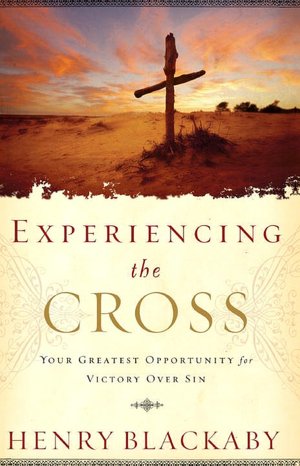
Experiencing the Cross – Henry Blackaby


Experiencing the Cross: Your Greatest Opportunity for Victory over Sin
©2005 Multnomah Publishers, Sisters, OR

Henry Blackaby has been a favorite of mine ever since I first went through the material he helped develop called Experiencing God. Not only is he an influential leader in Baptist life, but he is also a very personable man when in speaking situations. A couple of years ago, I had opportunity to meet and visit with him for a few minutes as he spoke at a pastors’ retreat I was attending. While I am not always overwhelmed by Henry’s writing (often finding in it a re-packaging of Experiencing God), I am always ready to hear what he has to say or read something he has written.

This little book is yet another testimony to the readability of his writing. And the content is very challenging and helpful. In Experiencing the Cross, Blackaby draws the reader’s attention back to the focus of the cross—why it happened, why it had to happen, and what happened because it happened.

Using Scripture (a hallmark of the author), Blackaby leads us to see God’s plan in the event of the Cross. He then teaches us what that means for believers and non-believers in Christ alike. Finally, the author leads the disciple into a deeper discipleship about what is meant when the Scripture says that in order to follow Jesus one must “take up his cross” and follow Him.

This volume is filled with challenging and encouraging teachings that will help Christians to better understand and appreciate the cost of the Cross as well as the life to which the Cross calls all who would dare to follow Jesus. I recommend this book highly to anyone who desires his faith to be more vibrant, more active and more genuine. Five out of five reading glasses.

—Benjamin  Potter, October 26, 2012

Thursday, September 1, 2011

Enemies of the Heart – Andy StanleyEnemies of the Heart – Andy Stanley

© 2011 Multnomah Books, Colorado Springs

This year, Andy Stanly decided to re-release a repackaged version of It Came from Within. The result is this little volume subtitled BreakingFree from the Four Emotions That Control You. The original had always been tempting to me because it had much cooler if exceedingly less relevant cover art. In this book, Stanley deals with issues of the heart; those things which keep us from doing what we know is right. He addresses those things that make us say, “Where did that come from?” “That’s not like me,” and similar exclamations when we say something or act in some way that seems totally out of character.

The simple answer to the question of where that (comment/action) came from is “It came from within.” Those out-of-character, less-than-stellar reactions that we encounter from time to time are an outward expression of something that is going on deeper down, in our heart (using the term metaphorically to represent our spiritual self). Stanley carries the example through well in the book relating our spiritual condition with the physical condition that relates to our heart—and what causes heart disease. Physically, we understand it is poor habits—whether at the gym or at the table. The author asserts that we can practice daily exercises in our spiritual lives that will strengthen our spiritual heart in the same way.

Stanley identifies four culprits that rob us of our spiritual heart health: guilt, anger, greed, and jealousy. He includes the analogy of debt to represent each of these. Guilt says I owe you; anger says you owe me; greed, I owe myself; and jealousy, God owes me. He builds a pretty good case for each of these dynamic debts including Scriptures that address each one. He doesn’t simply point out the problem, though. Stanley is sure to offer a solution to overcoming each of these behaviors. Simply put, he suggests developing habits that defeat these enemies—confession, forgiveness, generosity, and celebration. He closes the book with a chapter on passing these good habits to the next generation living in your house, and a short chapter on lust which he claims is an appetite to be managed rather than an enemy to be overcome.

The book is a great means to address the underlying issues that result in the ugliness that is sin in our lives. The only drawback that I see in the book is that it leans toward the misconception that we are able to develop any of the overcoming habits outside of faith in Christ. Not that this is the intent of the author, just an observation about the book. In any case, I would recommend this manual on moving beyond the destructors of our relationships to any believer in Christ, and give it four and one-half reading glasses.
 
—Benjamin Potter, September 1, 2011

[Disclaimer: I received this book for free from WaterBrook Multnomah Publishing Group for this review.]

Thursday, October 14, 2010

Experiencing the Resurrection – Henry & Melvin Blackaby

© 2008 Multnomah Books, Colorado Springs


Sometimes you expect something. It’s that way when I pick up a book that has Henry Blackaby’s name attached to it. He has been helping his children get their start in publishing good studies for Christians over the last few years. Typically, because of his work in Experiencing God, I tend to expect one of two things from Blackaby: stating the obvious in a fresh, new way and thus extracting from his readers that “I knew that” moment that challenges us to open our eyes as we live (as happens every time I revisit the EG material); or I find myself looking for that re-hash of the EG material without calling it Experiencing God.


Interestingly, you find neither of these things in Experiencing the Resurrection. What you find is somewhat of an enigma, especially for Blackaby. While there is nothing readily identifiable as profound, neither do you find anything really objectionable. It seems to be an almost entirely unnoticeable book. It is rather light in the realm of theological texts, and on the safe side, with the one possible exception being the chapter on “Resurrection Hope” which focuses entirely on heaven. My personal issue with this is the claim that the hope and glory that we have as Christians is manifested in heaven. The reality (scripturally, which is why it’s disappointing to find this in a Blackaby book) is that our hope is embodied in Christ. When we focus our hope on anyone or anything other than Christ, we miss the point. Certainly, we look forward to eternity in heaven, but our hope lies solely in Christ.


Is this book worth your time? Perhaps, but I wouldn’t recommend that you rush right out and buy a copy unless you are in need of a book to remember the Resurrection by. For a lackluster effort, I give a lackluster two reading glasses.


Benjamin Potter, October 14, 2010

Tuesday, November 25, 2008

Worldliness – ed. C.J. Mahaney


©2008 Crossway Books, Wheaton, IL

With a Foreword by John Piper, and cover blurbs from the likes of Randy Alcorn, D.A. Carson, and Mark Dever, this little collection of essays would seem to be the perfect tool for helping Christians grow in their faith. The subtitle gives the reader the gist of the book: Resisting the Seduction of a Fallen World. This is not an effort to identify worldliness as much as an attempt to remind Christ followers of the need to be separate from the world.


The editor, Mahaney, sets the stage for the scope of the book with the first (I’ll call them) sermon. The focus of the book is on a verse in 1 John (2:15) which reads, “Do not love the world or anything in the world.” An explanation ensues to put into context the difference between the term world John uses here and when he writes “God so loved the world . . .” in the gospel bearing his name.


Other sermons included in the collection deal with the Christian and Media (Craig Cabaniss), Music (Bob Kauflin), Stuff (Dave Harvey), and Clothes (Mahaney). The final entry is a work by Jeff Purswell on “How to Love the World”.


This book will be a challenge for some, a stumbling block for others, and just another book to still others. It is not a book for a wide-ranging audience. It is written to help Christ followers grow in their walk with the Master. It will likely anger many of those who number themselves in the Christian community because of the high standard that is espoused. The writers themselves admit to struggles with meeting the ideals put forth in the writing.


In general, I find the collection to be faithful to the Scripture. The authors take to task a generation of believers who have allowed worldliness to infiltrate their numbers to the point of being no different from the world. It is because of this worldly trend in the church that many readers will get angry and toss the book out the window. It is also this trend that makes a book like this sadly necessary.


As with any book of this type, some readers will latch onto the truths pointed out and use them as a sledgehammer to cream their neighbors with. Giant football fingers will be donned to point at the sinners who need to take this chapter or that to heart. Many will use the essay/sermons in this little book to gain new heights in legalism. Such is the danger of any book like this—and often of any sermon that takes seriously the teachings of Jesus and the Apostles.

Most of the chapters dealing with specific areas where worldliness is increasingly tempting are well written and founded faithfully to scripture. While the fashion chapter is lopsided toward women and can be seen as chauvinistic, Mahaney points out the reasoning behind his focus on women’s fascination with worldly fashion.

The closing chapter is probably the least coherent of the essays and might seem a little awkward in a book designed to help us turn away from the world.


Included in the book are thought questions for each chapter and a couple of appendices which address more specifically ways that women can be more scriptural when choosing the clothes they wear.


I don’t recommend this book for wide circulation—even among the Christian community. I do, however, believe that this would be an excellent tool in the hands of someone who desires to become more like Christ. Because of the concerns I have with the book being used as a foundation for legalistic finger pointing, I have to hold it to three out of five reading glasses.


—Benjamin Potter, November 25, 2008
Thursday, June 21, 2007

Confessions of a Pastor – Craig Groeschel


As a pastor I receive these mailings called “Pastor Ministry Cards.” They are filled with advertisements and mail-in cards to help me in my ministry. I usually skim through them quickly just in case there is something useful for me or the church inside. A few months ago I received a similar mailing. This one was more of a catalog than a packet of cards, but the premise was the same. I thumbed through and found an offer for a free book—just go on-line to this address and click on that link and register for your book. I’m all about free books, especially those that promise to help me in my ministry. A few days later I received this book. I’ll start by saying it was worth the price, and if I had known how good it was, I would have paid cover price and read it long before now.

Craig Groeschel is the founding pastor of a megachurch. He’s trying to get real. Part of the way he is doing this is by publishing his “Confessions”. Inside the covers we learn of his battles with being the best pastor that he could be, his doubts about his own ability, his struggles with sexual sin and loneliness. We learn that even though he’s the pastor of a fast-growing, multi-location church, he’s just a regular person. Wouldn’t it be nice if all our pastors (present company included) would admit to their own humanity?

From the introduction in which he admits to living a lie—wearing a mask in order to seem to be the person that others want to see—to the close of the last chapter in which he challenges the reader to become real too, Groeschel makes you realize that you need to own up to your own personal shortcomings as well.

Perhaps the most telling confession for me was in the chapter that the author dealt with fear of failure. My own fear of this giant often keeps me from stepping out and doing something for the Kingdom. And that’s his point. If we will admit to our shortfalls, confess our obsessions and guiltiness, God can take us and use us. Here’s the deal: God already knows that we don’t like some people, that we gossip, that we lust, and we lie. If we will admit, confess these things, we release them to the One who can help us overcome them. It doesn’t make it okay to practice these things, but it allows God to know that we know who we are and we will stop trying to be someone else.

I recommend this book to ministers and lay-persons alike. Anyone who is a Christ follower and wants to become more like Jesus will benefit from reading this book. I recommend it for small group study—men’s groups, ladies’ groups, young or old adults. I recommend it, but with a warning. You may find the mirror he is holding up shows an ugly picture. You may become angry or embarrassed by what the book forces you to reveal to or about yourself. It’s hard, but it’s worth it. And Confessions of a Pastor is worth the read.

—Benjamin Potter, June 21, 2007

Thursday, May 31, 2007

EKG: The Heartbeat of God – Ken Hemphill


I will admit that I was originally skeptical when Ken Hemphill was tapped to succeed Russell Dilday as president of Southwestern Baptist Theological Seminary. Perhaps it was my distrust of the way that Dilday was disposed of. It took some time for me to get over political issues and give Hemphill a chance, but I was surprised to learn that his heart was beating in much the same realm as mine. That led me to finally purchase and read this book.

EKG (Empowered Kingdom Growth) is the desire to live in the Kingdom of God and develop as a Kingdom citizen. The book does not hit home runs throughout, but it does strike a resounding chord. The most engaging portion of the book is the commentary put forth for the Sermon on the Mount (Matthew 5-7). Hemphill makes the Beatitudes come to life, the salt/light and law passages begin to vibrate, and then he whets our appetite for prayer with a glance at the model prayer. What is distracting is that this major portion of the book doesn’t even start until you have waded through half the pages. Many, I’m afraid, won’t stick with him to get to these nuggets of gold to be mined.

The thrust of the book is to challenge people to ask some poignant questions:

  • Am I a Kingdom person?
  • Are we a Kingdom church?
  • Do you want to be?

These questions are useful for every Christ-follower to ask. The answer to the third may influence the way that we address the first two—how do I/we become one?

If you are looking for a feel-good book to help you bolster your current way of life, skip this one. If you want to read something that will challenge your theology, look elsewhere. If you are looking for a resource to help build Kingdom-mindedness into your life and your church, then this is a good place to start.

Popular Posts

Labels