Showing posts with label Christianity. Show all posts

Tuesday, June 13, 2017

Not All Roads Lead to Heaven – Robert Jeffress


©2016 Baker Books, Grand Rapids


When I was a high school student I was part of the team. I did not play football, basketball, or baseball, but I was on the team—the speech and debate team. I will readily admit that I was neither exceptionally nor remotely gifted in the art of debate. In fact, at tournaments, I begged our debate coach to let me just participate in the speech events that I enjoyed. But alas, she always made me partner up with my buddy and lug our cases of cases and evidence into the debate room where we would participate in two to three rounds of debates usually being eliminated early.


As you can see, dear reader, I have not decided to make apologetics my life ambition. I’m just not going to go out of my way to get into a theological debate with someone. Even so, there are times when I find myself in a situation that requires me to bring an answer for my faith—and often the questions are difficult. What is a Christian to do when it comes time to stand up for faith? That’s where it helps to familiarize oneself with people who have a gift for defending the faith.


That is where Robert Jeffress, senior pastor of FirstBaptist Church in Dallas, Texas, and his recent book come in handy. Dr. Jeffress is no stranger to defending Christianity. He has been interviewed on countless occasions where faith matters arise. He has found himself on the debate stage with noted opponents to the Christian faith and shown well. And so he has written Not All Roads Lead to Heaven to help the average Christian understand and defend the doctrine of exclusivity (that Jesus Christ is the one and only doorway into eternal life).


Jeffress address some of the most often voiced objections to and questions about the claim of Christianity that Christ is the only answer to questions about salvation. He bases his answers to these tough questions in Scripture (both Old and New Testaments) and weaves his way through the maze of logic that has tripped many a Christ-follower. Some of the loudest objections [exclusivity is intolerant; what about someone who’s never heard about Jesus? What about little children?] with care, understanding, and a better response than the typical defensive sarcasm that touches the lips of many Christians. The author reminds the reader of a couple of important notes that should be remembered whenever we encounter someone who wants to question our faith: We are dealing with God and His ways, and God’s desire is to see as many people come to salvation as possible. If we are to find salvation, we must do it on the terms of the Author of salvation, though, and not what seems like a good idea at the time.


This book is a short, readable guide to answering questions that a Christian might have about how inclusive the gospel message is; a resource to approaching non-believers (both friends and acquaintances) who might take issue with the exclusive claims of Christianity; and a study to acquaint the believer with a stronger foundation as to how to approach the doctrine of salvation—after all, it is by grace through faith in Jesus Christ (and only Jesus Christ).

I give this book 4.5 out of 5 reading glasses as at times it gets a little weighty, although Dr. Jeffress does an excellent job of keeping the complexity of the issue simple most of the time.


—Benjamin Potter, June 13, 2017


Tuesday, July 1, 2014

Read but not Reviewed (Recommended Anyway)

While I like to respond to as much of what I read with a thoughtful opinion in the form of a quick review, I don't always fulfill this desire. I am a fairly slow reader because I have to digest every word. Then, I want to be truthful and thoughtful when I do write my opinions down. When life gets hectic, I find that just fulfilling the normal duties of a small-church pastor can keep me from setting my thoughts to keyboard. So, I thought I'd just give a quick recommendation concerning a few books I read in the first part of the year (and then maybe I won't feel so bad about getting to the next--freshly read--review).

Compound Murder (A Sheriff Dan Rhodes Mystery) by Bill Crider (Minataur, 2013). As with anything by Bill, and especially starring the Blacklin County Cast headed by Dan Rhodes, I heartily recommend this book. I read it around Christmas and the next installment is supposed to hit stores next month, so I thought I'd better at least mention this one (4 reading glasses).

Mere Christianity by C. S. Lewis (Harper Collins, 2000 edition). I finally got a chance to give this classic defense of the Christian Faith a good solid read and found it to be timely and quotable. This is a book anyone should read. It has my highest recommendation (five reading glasses).

Too Busy Not to Pray by Bill Hybels (IVP Books, 2008, 20th Anniversary Edition). This one is a modern classic on prayer, It is another challenging read with much advise. I recommend it for the Christian who wants to dive deeper into their own prayer life. (4 reading glasses)


Wednesday, August 14, 2013

10 Sacred Cows in Christianity that Need to Be Tipped – Jared Moore


© 2013 CreateSpace

When Jared Moore, pastor of New Salem Baptist Church in Hustonville, Kentucky, offered a few copies of his new study “Ten Sacred Cows” up for review, I signed up. He explains that sacred cows are traditions that have moved from the place of practice to the position of worship in our churches. Some of these are simply practices that have become more than comforting to parishioners, others are points that have been adopted by ministers as they lead local churches in a direction not intended in Scripture.

Moore chooses ten and discusses why they are poor theological substitutes for the God we should be worshiping. I would suggest that the list might be expanded and modified as each local church is studied for practice and procedure.

Concerning the booklet itself, it is a relatively short read (slow reader that I am, it took me about thirty minutes to read and digest the whole thing—including acknowledgements). The cover leaves a little bit to be desired, though. The stick drawing of a cow that is periodically standing or “tipped over” gets the point of the exercise across, but won’t see the study taken as seriously as the author would like.

Be that as it may, I think the little study has merit on its premise, but I should like to see it do a bit more than it does. The book serves to introduce and simply define the “sacred cows” within it. There is even a glancing blow at “tipping” them. Each topic is only give a couple of pages’ discussion—some expansion would prove to be healthy for the topic. As a matter of fact, the book itself reads a little more like a book proposal (and I’d probably read the expanded version, too).

Here are the “cows” which Moore introduces to us:
  1. Entertaining Sermons – not that sermons being entertaining is bad, but that making them so for the sake of entertainment is (lesson to preachers: don’t bore your audience, but be preachers not stand-up comics)
  2. Anything for Souls – the idea of “buying” your audience.
  3. Numbers Equal Revival – the struggle of many preachers (especially Southern Baptists like Moore and myself) to judge the success of ministry with the bottom line of numbers/
  4. Experience-Centered Worship
  5. Nostalgia – the “good old days”
  6. Relevant Sermon – always beware of buzz words.
  7. Relativistic Interpretation
  8. An Easy Life
  9. Tolerant Love
  10. Successful Ministry

Some of the “cows” chosen by the author bear a bit more explanation that others, and the two to three pages spent on each one gives less than adequate time for either the explanation or the debunking, and certainly not enough to both. If the purpose is to start the conversation, then the study is a good one. However, the assumption of agreement on behalf of the reader may be a little optimistic without a bit more detail.

I think this is a pretty good start because with the slightly humorous approach, Moore keeps from sounding overly curmudgeonly in his discourse. For that I give high marks. As I’ve stated, though, the book would do well to have a bit of expansion on the ideas. (3 out of 5 reading glasses)

—Benjamin Potter, August 14, 2013

[An electronic form of this book was made available by the author for the purposes of review. I have not been otherwise compensated for this review all opinions are that of the reviewer.]

Thursday, December 6, 2012

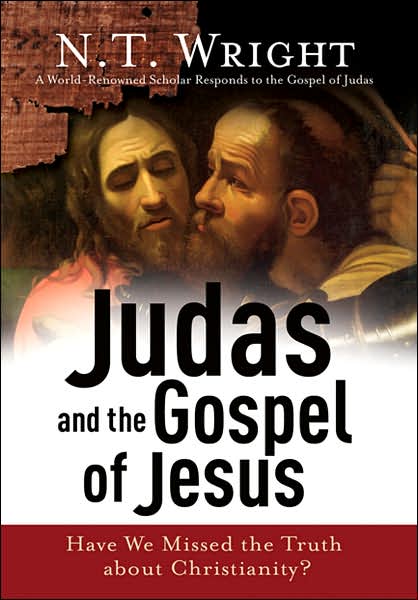
Judas and the Gospel of Jesus – N. T. Wright


Judas and the Gospel of Jesus: Have We Missed the Truth about Christianity? 

©2006 Baker Books, Grand Rapids

The name of N. T. Wright is fairly familiar in the arena of theological thinkers. Modern Christian ministers, if they haven’t read some of his writings or about him in places like Christianity Today, have at the very least heard the name or seen it on the spine of a book or two when they were looking for the latest pop culture influenced book at their local Christian bookstore. Wright is not only a bishop in the Church of England, but is a Biblical historian and teacher of New Testament at institutions such as Oxford and Cambridge.

In recent years when another “new” gospel started creeping into theological circles, he half-heartedly ordered a copy of the translation and began piecing together what this so-called “Gospel of Judas” had to add to serious theological study. What he found was an authentic third century document that attempted to discredit and/or “correct” the New Testament account found in the canonical gospels (Matthew, Mark, Luke, and John).


Lauded by modern-day Gnostics, the document in question is part of a larger find which was discovered in the 1970s but was not finally studied and translated until thirty years later. The text of the document, while not considered a forgery and hoax (as many Believers would hope), turns out to be an early Gnostic tale about how Judas Iscariot was really the hero of the New Testament story because he was acting in obedience to Jesus in His conspiracy to rid Himself of the earthly body in which He was trapped.

This and several other heretical Gnostic teachings are addressed in this book of historical apologetics. Wright takes time to explain some of the basics of Gnosticism and contrast them with what has been taught as orthodoxy throughout the centuries. Ideas like the Creator-God is evil and should not be worshiped as should the greater gods than He. Wright does two things in this short and readable book that are well worth the reader’s time to see:
  1. He sets aright the true Gospel in contrast to what proponents of this “new gospel” have tried to topple—namely, the Biblical record of Christ.
  2. He addresses issues that seem to sidetrack modern-day Christians who get caught up in one tangent or another in their faith-walk. In doing so, he reminds readers that they need not fear what intellectuals with big vocabularies are spouting when we have Truth on our side.

Conservative Evangelicals will thrill and cheer as Wright discredits the Gnostics and the supporters of this new “Gospel of Judas.” But then we begin to understand the audience of the Old Testament prophet Amos when he was proclaiming the oracles against all the nations surrounding Israel. You might recall that each nation was called down for their sins against God. Finally, the prophet narrowed the focus to Judah and then to Israel herself—and the proclamation against Israel was far more serious than that of her neighbors because of the depth of her transgression. Israel, after all, as a nation was “the people of God” and should have known better.

In this same manner, Wright after setting the scene for the dismissal of the Gospel of Judas as authoritative (even if it is an authentic third century document) and Gnosticism in general (either the early New Testament era version or the more modern variation), he levels his sights on the modern evangelical movement (American Protestantism in particular) to call us on our propensity to amalgamate certain teachings of the Gnostics into our own instruction just to keep from having to take part in debate over issues we’d rather ignore. The last chapter of the book is a bit harder to take, but its truth cannot be denied. We as Christians ought to be less defensive over our man-made traditions and more concerned with living as the Scriptures dictate.

Even though I feel a bit scathed having read the last pages, I can’t help but give Wright four and one-half reading glasses. This defense of the True Gospel in light of late archeological discoveries which would try to disprove that Gospel is one that will be helpful to both the academic and the layman alike. It will help you know more why you believe what you believe about the Passion of the Christ.
 
—Benjamin Potter December 6, 2012

Friday, April 27, 2012

Crazy Love – Francis Chan


Crazy Love – Francis Chan (with Danae Yankoski)


© 2008 David C. Cook, Colorado Springs

I’ve been hearing good things about Francis Chan for several years. I have been interested in reading his books since they first hit the bookstores about four years ago with CrazyLove. I just couldn’t bring myself to pay the high prices that were required by the publisher. Then Easter weekend, eBook sellers were offering a deal on all three of Chan’s titles (get them for your eReader—in my case Nook—this weekend for free). That’s right I was able to snag all three for free (they are back up to about five dollars again). So, starting today, I’ll be reviewing them.

Crazy Love is as challenging as David Platt’s Radical. The point of the book is that Chan wants to challenge Christians to live their Christian life as if they know Christ. The author’s candor and sincerity are evident in the writing. It is well-written and compelling. I know that as a result of reading, I personally am interested in becoming more Christ-like in the way that I live out my everyday life.

There is one caution that I would place on the reader. As the book progresses towards the last chapter there is a tendency in the reading to push the reader to (ultimately) embracing a social gospel. I do not believe that Chan himself adheres to such a stretching of the true Gospel message. His attention to Scripture command is too detailed to expect that he would espouse a gospel message that relies more on social action than on faith in Christ. At the same time some of the later chapters could lead the reader into just such a life.

Having said that, I think that every Christian would benefit from reading this short book. It brings to light the fact that a giant portion of the American church is filled with people who have “walked the aisle,” “said a prayer,” or other church-esque means of protection from going to Hell (or insurance of going to Heaven), without need for true commitment. Don’t read this book if you are fully satisfied with your life. You will not be able to stay the same if you really take the book to heart.

 
Chan rates four and one-half out of five reading glasses for Crazy Love.

—Benjamin Potter, April 27, 2012
 
[This is a review of the Nook version of this book.]

Popular Posts

Labels